


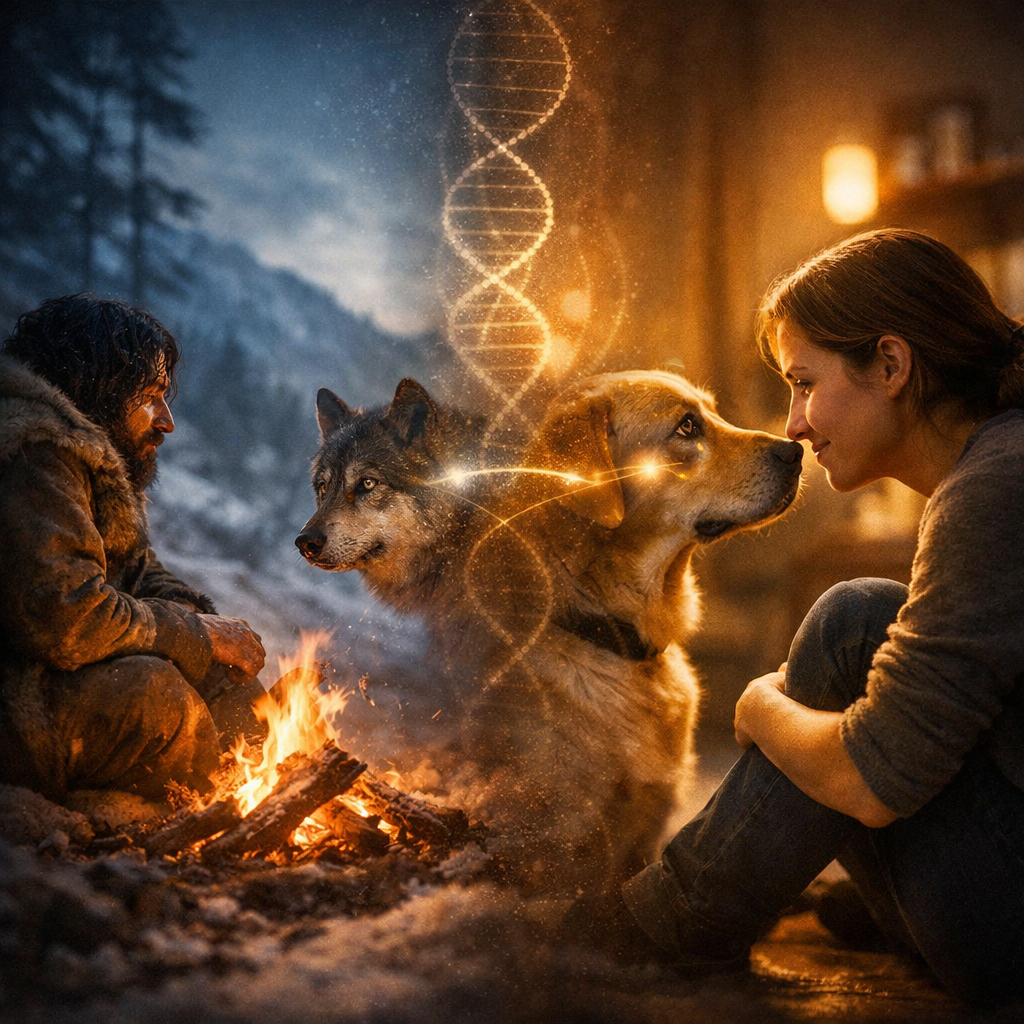
In the modern world, dogs are no longer viewed merely as working animals or property—they are companions, emotional anchors, and, for many, true family members. Science now confirms what dog lovers have long felt instinctively: the bond between humans and dogs is biologically unique. Understanding where dogs came from, how they perceive the world, and what shapes their behavior allows us to care for them not just affectionately, but intelligently and ethically.
1. The Origin Story: From Wild Wolves to Human Partners
The First Domesticated Species
Archaeological and genetic evidence shows that dogs were the first animals domesticated by humans, predating agriculture and the domestication of livestock.
Estimated timeline: Between 15,000 and 30,000 years ago, during the Late Pleistocene era.
Key evidence: Fossil remains of dog-like canids buried alongside humans in Germany (Bonn-Oberkassel site, ~14,200 years old) suggest emotional and social value even then.
Genetic lineage: All domestic dogs belong to the species Canis familiaris, descended from the gray wolf (Canis lupus).
How Domestication Likely Happened
Rather than humans capturing wolves, scientists believe domestication was a process of mutual self-selection:
- Less-aggressive wolves began scavenging near human camps.
- Humans tolerated these animals because they helped clean waste and alerted them to danger.
- Over generations, wolves with calmer temperaments reproduced more successfully near humans.
- Natural selection favored traits like reduced fear, smaller skulls, and increased sociability.
This process is sometimes called 'survival of the friendliest.'
Co-Evolution With Humans
- Dogs developed the ability to interpret human pointing gestures, something even chimpanzees struggle with.
- Genetic studies show dogs evolved extra copies of the AMY2B gene, allowing them to digest starch-rich diets as humans shifted to agriculture.
- Oxytocin ('the bonding hormone') rises in both humans and dogs during eye contact, mirroring parent-child attachment biology.
2. Sensory Superpowers: How Dogs Experience the World
Dogs don’t perceive reality the way humans do. Their brains prioritize smell and sound over vision, creating an entirely different sensory hierarchy.
The Nose: A Biological Marvel
A dog’s sense of smell is its primary tool for understanding the environment.
- Humans have ~5–6 million olfactory receptors, while dogs may have up to 300 million.
- Dogs can detect concentrations as small as one part per trillion, enabling medical detection, search-and-rescue tracking, and emotional sensing.
- Dogs also possess a vomeronasal organ (Jacobson’s organ) that detects pheromones—chemical signals invisible to humans.
Hearing: Built for Survival
- Dogs hear frequencies ranging from ~40 Hz to as high as 60,000 Hz, far exceeding the human upper limit of ~20,000 Hz.
- Their independently rotating ears help pinpoint sound direction with remarkable accuracy.
Vision: Not Black and White, But Different
- Dogs are dichromatic, meaning they see primarily blues, yellows, and grays.
- They excel at detecting motion and seeing in dim light due to the tapetum lucidum, a reflective retinal layer.
3. Canine Cognition and Emotional Intelligence
Modern behavioral science has dismantled the myth that dogs operate purely on instinct.
- Research suggests dogs possess problem-solving ability similar to a 2–2.5-year-old human child and can understand 150–250 words or signals.
- Brain imaging studies show dogs’ reward centers activate strongly in response to their owners’ scent.
4. Understanding Dog Behavior: Communication Beyond Barking
Dogs communicate primarily through body language rather than vocalization.
- High-pitched barks signal excitement, while low growls warn of discomfort.
- Tail position, posture, and facial expressions convey emotional states.
The 'Alpha Dog' Myth Debunked
Dominance theory originated from flawed captive wolf studies. Modern research shows dogs respond best to positive reinforcement, predictability, and trust—not intimidation.
5. The Extraordinary Diversity of Dog Breeds
Selective breeding over thousands of years produced one of the most diverse species on Earth, with over 350 recognized breeds.
Working dogs, herding dogs, hounds, sporting dogs, and toy breeds were all shaped for specialized roles that still influence their behavior today.
6. Health, Lifespan, and Responsible Care
- Smaller dogs typically live 12–16 years, while large breeds average 7–10 years due to faster biological aging.
- Common breed-linked conditions include hip dysplasia, respiratory disorders in flat-faced breeds, and obesity.
- Dogs require mental stimulation, physical exercise, and social interaction to remain healthy.
7. Dogs in Human Society Today
Dogs now serve as service animals, therapy companions, detection specialists, search-and-rescue partners, and conservation aides—demonstrating extraordinary adaptability shaped by thousands of years alongside humans.
Final Reflection
The human–dog relationship is not ownership but a biological alliance shaped over millennia. To care for a dog responsibly is to recognize this shared history: we are not just raising pets—we are continuing the oldest friendship our species has ever known.